

So instead of giving me a narrative that detailed his actions throughout history, he gave me something else, in which I think he is entirely present, albeit in a rather complex way. He gave me very rich responses to how he relates to history and place, in both explicit and subtle ways. But the way he gave it—that is, through his interpretation of history—is something that I’m not entirely sure I know how to deal with because it isn’t firsthand. But it is as close to firsthand as possible, and I think that his motivation for talking about history and researching events, places and artifacts is to experience history in a way that simulates firsthand experience. I think that this is something that’s really unique—I don’t know how my fellow students or my instructors will think about this. Is it an utter failure to interview someone about events that preceded their birth?
Aside from the premise of the interview possibly being problematic, I know for sure that some of my questions were way too long—or at least too explicitly full of my struggle to launch my question from a particular idea. Mary Marshall has talked about putting our idea into our question, but I realized I have a tendency to state my reasoning for asking a question before stating the question. So I have definitely not mastered the two-sentence question; a few times I was just thinking out loud (which is so clear in the transcript). Also, my attempt to talk a bit about myself in order to encourage him to respond in kind came off more like a personal indulgence than a way to set the stage for the type of narrative I wanted him to provide—that’s also something that I need to work on, though I wonder if all this is aggregating and could work to my advantage in a future interview.
One of the questions he responded to without my asking related to whose stories were excluded from the General Grant National Memorial, which he explained were the stories that addressed the continuing struggle of the formerly enslaved African and African-American people and their descendants. In this way, the Memorial is very clearly a monument to an idea—that the Civil War was a worthwhile and valiant moral battle—rather than to the realities of rebuilding infrastructure and dealing with the manifestations of a still-present racism within that new infrastructure throughout the South and the North as well.
It’s interesting that the structural renovation of Grant’s Tomb, as well as its organizational infrastructure, were both major topics in my original project design. Yet those are not the topics that people seem to want to discuss. Just like the details that make the story of the Civil War such a horrifying experience, maybe the specifics of the Tomb’s restoration combine to form a story that no one really wants to talk about. The Tomb seems—in a lot of ways, and despite its enormous physical presence—to be a springboard for a discussion of ideas and intention, and less a place for the discussion of concrete (literally, in this case) events.
Why is Gra
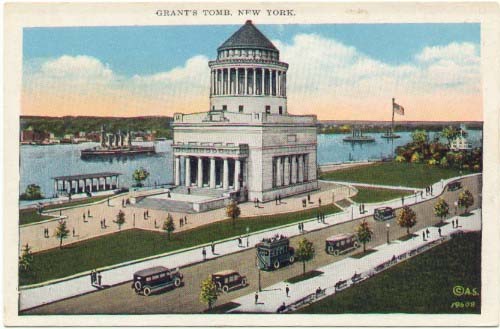 nt’s Tomb so much more of a symbol than a real space? Does anyone ever even go inside it? Maybe that’s the beginning of the problem!

No comments:
Post a Comment