November 30, 2009

Grant's Tomb Project Interview: Peer Review

No one took issue with the fact that my interview with SL was mostly about the Civil War, and not about S’s life—that was my main fear. I’ve been thinking a lot lately about how I seem to be moving into the future by looking farther and farther into the past. I mentioned this to a friend of mine who told me about the drawing by Paul Klee of the Angelus Novus, and Walter Benjamin’s description of this figure in his Theses on History:

IX
My wing is ready to fly
I would rather turn back
For had I stayed mortal time
I would have had little luck.
– Gerhard Scholem, “Angelic Greetings”

There is a painting by Klee called Angelus Novus. An angel is depicted there who looks as though he were about to distance himself from something which he is staring at. His eyes are opened wide, his mouth stands open and his wings are outstretched. The Angel of History must look just so. His face is turned towards the past. Where we see the appearance of a chain of events, he sees one single catastrophe, which unceasingly piles rubble on top of rubble and hurls it before his feet. He would like to pause for a moment so fair, to awaken the dead and to piece together what has been smashed. But a storm is blowing from Paradise, it has caught itself up in his wings and is so strong that the Angel can no longer close them. The storm drives him irresistibly into the future, to which his back is turned, while the rubble-heap before him grows sky-high. That which we call progress, is this storm.


This is not quite the description I’ve been looking for. I might think of the past as a “rubble heap,” but I do not imagine that it’s “one single catastrophe”; instead I think of this rubble heap as I would an attic—it maybe be messy but I believe it contains such treasures! And not only treasure, but collections of treasure that can be ordered either by chronology or by theme or by type.

What I’ve really been trying to wrap my head around is how to describe the way time expands and contracts in the past. It is certainly not like the minutes and hours of the present and future because the past is not experienced as such. But it seems like the more details I have about the past—the more items I pull from the rubble and put into order—the more time there is back there! Time has to expand to make room for what I know and have to think through as I’m ordering it.

As much as I hoped my interview with SL would be about place, I wonder if it’s more about time. Specifically, SL presents his unique way of relating to history, which is through a very ready movement time. We really didn’t get into his experiences with Grant’s Tomb, and I wonder if place is, in some ways, an imposed framework for understanding reality, which is just as tricky to negotiate in an interview as a woman's experience of her subjectivity. Maybe a researcher can’t ask for a person to talk about their relationship with a place and expect that a place will always be explicitly present in the narrative.

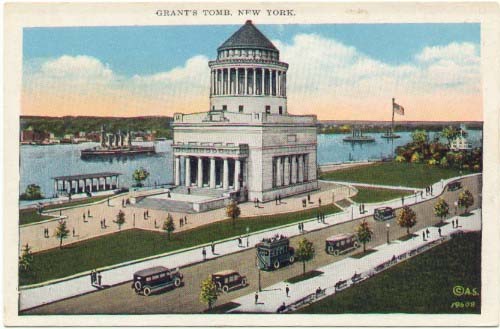
Maybe as my interviews go on, it would be more useful to see what people who are somehow related to Grant’s Tomb wish to talk about instead of Grant’s Tomb. If Grant’s Tomb is so much a symbol that it’s barely a real space, maybe that’s the topic that should be researched, rather than trying to uncover that relationship to see what’s under it. Then again, I really hate symbols precisely because they look beyond the thing, rather than at it. Maybe the real work of my follow-up interviews will be to bring people back to the place—maybe to literally make people walk around through the space—to confront its realness, its monstrous shape, its silent residents: Mr. and Mrs. Ulysses S. Grant.


November 12, 2009

Photography Workshop

A few of Janelle Covino’s ideas about the uses of photography in oral history were really inspiring, especially her outline of how photographs can be used to document the process of interviewing, which includes getting to the interview, researching the person, corresponding—in general, collecting and creating artifacts that add to the contents of the interview.

I also really like Janet Cardiff’s audio walks. After listening to a few excerpts from her website, I wish that there were fewer explanations of emotions, and somehow the evocation of memories seems a little wrong to me—I guess I wish she spoke in the first person instead of the second. But the overall idea of multidimensional audio and retracing paths is really exciting to me. The National Park Service recently started doing audio tour podcast projects, and I have listened to some of the tours for lower Manhattan for the New Amsterdam Tour. Steve Laise narrates on these tours, which is a little funny to me—as if I haven’t listened to this person’s voice enough!


♥ What is the image’s documentary potential? How does it present fact to the world?

- August Sander, The Last People

- Reneke Dykstra, The Bathers
♥ Does the image contribute to the audio? Does it express posture, body?

♥ Does the image display an artifact? How can a person be defined by objects?

- impact on the grass: traces of the body

♥ Does it illuminate the environment of the interview?

♥ Does it convey the passage of time?

- Nicholas Nixon, The Brown Sisters

♥ Does it convey my relationship to obtaining information?

- route to a person or place

♥ Does it represent content: symbol of the past, symbol of memory?

- Gerhard Richter

- Alan Berliner, Family Album

- Janet Cardiff, Her Long Black Hair walk


November 4, 2009

Life History Interview: Update

Unfortunately, I learned today that B has left GH and I won’t be able to do a follow-up interview with her. I’m not sure how much GH was her choice or how much it was required treatment, but I do know that she—to her understanding—doesn’t have a family or a home to go back to. So where she has gone and why she chose it is certainly a source of concern for me.

I really felt like the whole experience of working with clients at GH was a failed attempt to develop a mutually beneficial relationship. Instead it felt stronger as a concept than as a real exchange. Part of this, for me, stems from the way the interviews were introduced (or rather, not introduced) to the clients by GH staff. I don’t appreciate how I was tacit in treating these women like children, who were directed minute by minute throughout their day by people in charge. While I understand that structure is important, there is a difference between enforcing a structure for one’s benefit and enforcing a structure because of an underestimation of one’s capabilities.

Also, the experience of trying to get in touch with B through her counselor made me feel like I was bothering GH, rather than communicating my interest in Barbara as a person and her ability to teach me about herself and about my own abilities and shortfalls of oral history interviewing. It began to feel like a battle between institutions—Columbia and GH—and each institution’s agenda and priorities, and I as a student, and B as a client, were really dwarfed by this larger push and pull.

My experiences working at small non-profit organizations has shown me that there’s a huge difference between the stages of Project Design and Project Implementation; what’s added between those stages is audience and actors. Bringing in the people who are supposed to benefit from a project can be the point where a project becomes more of a hollow framework and less of a well-supported concrete strategy for development and change. I say this not so much because my experience working with B and GH failed to teach me anything (it taught me very much), but because it reminded me too much of struggles I have had organizing projects in my own experience. I guess I feel like I’m able to deal with the reality; that’s my job as a human being. As a student, however, I’m in this program to learn ideals and goals within the context of the discipline from my instructors, and to be able to follow those goals and ideals without being overwhelmed by institutional shortcomings. The necessity to engage these ideals with the world (and project partners, et al) is a constant dialectical process that I understand will go on forever, but moreso in the professional field than within the classroom. I would like to avoid feeling burned out as a student of a discipline before ever getting to practice the discipline.

But perhaps most importantly, it’s hard to describe the sense of loss I feel knowing that my contact with B has ended, and that her future is so uncertain. It would have been hard enough for me to complete the interview series and hear about her struggles even within the context of a full interview and follow-up. But the way our interaction ended so suddenly has left me fearing that I tried and failed to help her, and that my responsibility to her is unfulfilled.

November 2, 2009

Grant's Tomb Project Interview: Session One

I interviewed SL, who is the National Park Service Chief of Cultural Resources for the NYC Harbor Parks, Manhattan Sites. This was my first interview for my Project Design in Method & Theory, which deals with the history of the General Grant National Memorial. SL calls himself the “Parks Historian,” and he agreed to talk to me about the history of Grant’s Tomb and its relationship to the Civil War. He admitted that he didn’t have a lot of knowledge of the restoration of the Tomb in the 1990s, but I was still interested in what he had to say about the Tomb in a larger historic context. I was worried that he wouldn’t be present in his narrative—both because he was more compelled to participate in the interview because of the opportunity for him to talk about Civil War history (during which time he obviously wasn’t alive!), and because he had explicitly told me that he wasn’t comfortable providing his personal history.

So instead of giving me a narrative that detailed his actions throughout history, he gave me something else, in which I think he is entirely present, albeit in a rather complex way. He gave me very rich responses to how he relates to history and place, in both explicit and subtle ways. But the way he gave it—that is, through his interpretation of history—is something that I’m not entirely sure I know how to deal with because it isn’t firsthand. But it is as close to firsthand as possible, and I think that his motivation for talking about history and researching events, places and artifacts is to experience history in a way that simulates firsthand experience. I think that this is something that’s really unique—I don’t know how my fellow students or my instructors will think about this. Is it an utter failure to interview someone about events that preceded their birth?


Aside from the premise of the interview possibly being problematic, I know for sure that some of my questions were way too long—or at least too explicitly full of my struggle to launch my question from a particular idea. Mary Marshall has talked about putting our idea into our question, but I realized I have a tendency to state my reasoning for asking a question before stating the question. So I have definitely not mastered the two-sentence question; a few times I was just thinking out loud (which is so clear in the transcript). Also, my attempt to talk a bit about myself in order to encourage him to respond in kind came off more like a perso
nal indulgence than a way to set the stage for the type of narrative I wanted him to provide—that’s also something that I need to work on, though I wonder if all this is aggregating and could work to my advantage in a future interview.

One of the questions he responded to without my asking related to whose stories were excluded from the General Grant National Memorial, which he explained were the stories that addressed the continuing struggle of the formerly enslaved African and African-American people and their descendants. In this way, the Memorial is very clearly a monument to an idea—that the Civil War was a worthwhile and valiant moral battle—rather than to the realities of rebuilding infrastructure and dealing with the manifestations of a still-present racism within that new infrastructure throughout the South and the North as well.

It’s interesting that the structural renovation of Grant’s Tomb, as well as its organizational infrastructure, were both major topics in my original project design. Yet those are not the topics that people seem to want to discuss. Just like the details that make the story of the Civil War such a horrifying experience, maybe the specifics of the Tomb’s restoration combine to form a story that no one really wants to talk about. The Tomb seems—in a lot of ways, and despite its enormous physical presence—to be a springboard for a discussion of ideas and intention, and less a place for the discussion of concrete (literally, in this case) events.

Why is Gra
nt’s Tomb so much more of a symbol than a real space? Does anyone ever even go inside it? Maybe that’s the beginning of the problem!

October 22, 2009

Exhibits: Brooklyn Historical Society

What I really liked the most about the Vietnam Veterans exhibit at the Brooklyn Historical Society was how much time it required a visitor devote to learning about the experience of the Vietnam War—which was a great deal of time for a public display in a museum setting. I’ve been torn over what I like about museums and what I don’t. I was especially happy when I found the article “Why Museums Make Me Sad” by James Boon in Exhibiting Cultures: The Poetics and Politics of Museum Display because it was partly in agreement with my feeling that to edit so many stories or so many events or so many artifacts into a small representative sample was really a tragedy in its own way. I suppose Boon had a slightly different argument than mine, but I agree with him in the sense that a museum is both an ideal and a complicated place to learn history.


I visited the Merchant’s House Museum in September to see their exhibit on Mourning in the Civil War Era, which was a recreation of the mourning traditions of the 1860s—when The Merchant himself died. The museum had a coffin in the parlor, gauze over the mirrors, low lights in the chandelier, and—most eerily—a wax figure in the bed of the upstairs bedroom. This was all somewhere between fascinating and hokey. But I spoke to the woman working at the museum and she told me a few more facts about mourning practices in that era: clocks were stopped when a person died and not rewound until their body left the house; straw was spread on the street in front of a house where a person had died in order to quiet the noise from carriages and horse hooves on cobblestones; lilies were used during the wake to cover the smell of the body. She also explained that mirrors were covered in order to keep people from looking at themselves—if they expressed that order of vanity during such a solemn event, the recently deceased would notice and be sure to chastise them.


But I guess the relevant part of my visit to the Merchant’s House Museum related to the way that they presented the information that was contained in the house, and the way that they attempted to teach history through the site itself and the artifacts that it contained. When I entered the museum, I was given a binder of information and was instructed to go outside to the garden and read through some introductory information before I began my self-guided tour. So the first part of my experience was spent wandering around a garden and reading—I can’t really complain about that. The instructions in the binder then guided me back into the house through the entrance by the kitchen, and I was further instructed on the details of each room; which items were original to the house and which were authentic pieces that had been brought in more recently to replicate what had likely been present; how the furniture had been arranged and why and how its arrangement was known; what likely occurred in each room and how time was spent there—facts that were often ascertained by letters or diaries of the house’s residents, and then cited in the information packet.


Part of what I liked so much about the way information was presented there was that it was entirely up to me how much of the information I wanted to take in. I also liked that I interacted with the space, the artifacts, and the information pertaining to those things by myself because my attention was more focused than if I was with a group and a guide. It felt a little bit like detective work, or uncovering some dusty letters that told, in their entirety, the story of living in this place.


What I had thought was problematic about learning in this kind of way was that it overestimated the attention span or the commitment of the visitor to learning, or that it was basically a turn-off to find out that there was an “assignment” or duty of the visitor to be responsible for knowing certain facts before exploring the museum. But I suppose that this is how museums work: there is a certain contract to learn and to instruct. Asking a visitor to take in a lot of information (and therefore, learn) is, theoretically, what the visitor should want.


The full-body presence of the veterans in the Oral History Exhibition Hall was, I think, a way to suggest that visitors fulfill this sort of obligation to learn from an instructive space; to neglect to listen to any one of their stories was to fail to face that person, who was one of a group in a room and who had information to share that made him or her distinct from the others who were gathered in this place. I want to say that the recorded stories of the veterans included in the exhibit should have been enough, and that a full image of the speaker wasn’t necessary—but I only want to say that because I don’t think it will always be possible or even appropriate to include such an image with every exhibited voice. I also want people’s voices to stand on their own without any overt attempt to glorify their image or require that their speech in the language of art museums and cultural institutions. Does the voice make the cultural institution more accessible, or does the cultural institution raise the voice to an inaccessible status?


Perhaps the demand of time required to listen to oral histories, and how long people will devote to listening (and thus, how thoroughly interviews must be edited and whittled down from their original complexity), could be addressed by having exhibits that utilize oral history in public spaces where people can come and go freely and perhaps revisit. If there were story stations at places in a public park, for example, people could listen while they ate lunch, and then return to that place later and listen to more, or to other stories.


I guess the thing that I can’t help but think about, though, is that all of these experiences—listening alone, reading alone, exploring alone—are so isolating. Or maybe it’s that they’re intimate. I guess I could not really know each of my friends without spending time alone with each of them, away from other friends. What I do with a group of people is one thing, but what I do with one person is entirely another, and both of those sorts of scenarios are necessary to learning. So maybe it’s not too terrible to ask people to involve themselves in this isolating-intimate experience with a stranger or with strange artifacts, because it’s only through closeness (if not—yikes—immersion) that I or anyone else can know anything.


Regardless, I really appreciated the opportunity to talk about exhibit design at the Brooklyn Historical Society. There are so many fascinating decisions involved in matching the material to its ideal form for presentation. A friend of mine is a Creative Technologist at Local Projects, the firm who designed the Vietnam Veterans exhibit. I’m excited to think about what he and I might work on together, and how I can work with him to understand sound in public spaces, as well as museum exhibits.

October 15, 2009

Life History Interview: Session One

I was a little surprised to find out after arriving at GH this morning that the women we were there to interview hadn’t yet been told about us, or that they would be asked to talk about their lives at all. I imagined their anxiety, which then made me anxious. For some reason I had assumed that, while I would present a formal space for my interviewee to talk, I would also communicate to her that she was the expert on her life, and furthermore, that she was helping me learn about interviewing while she told a story that was familiar to her. In other words, I was overly self-conscious about seeming in some way powerful or authoritarian, and had envisioned how she and I would divide this abstract idea of power as though it was a pie that we would cut right down the middle. When we were told that the women were concerned about the interview and were afraid of exposing themselves to strangers, I immediately felt like I had to take charge of the situation; to display the pie intact before handing over any slices.

When I walked into the cafeteria to meet the women who we would be paired with, a woman who was sitting and finishing her breakfast immediately pointed at me and said “I want her. Can I have her?” And then she asked me “Will you take me?” And I said “Of course!!” and mentioned that we should check first with M, who the residents call Miss M. When M came in the room, the woman jumped up to ask her if she could go with me and Melanie looked to me for confirmation that that was alright and I, again, agreed enthusiastically. B was the name of the woman who chose me.


I didn’t ask why she responded to me the way she did. Maybe I looked the most or least frightened? Like I was the smallest? Wearing the brightest color? I guess her reason could be no reason or any reason at all. I suppose that, faced with an uncertain situation, she chose to make it certain by taking charge of her fate in this small way. But the details of the situation were that we filed in and stood awkwardly in front of a small group of women, and felt uncomfortable and not unlike objects, and B saved me from that and led me into the chapel where we did the interview and got me a chair and made sure we had an outlet nearby and took charge of me before I could even do one thing to present myself as in charge of her or myself.


So I wasn’t so uneasy and she didn’t seem so uneasy either, though at heart she seemed a little antsy. I asked her if she’d ever done an oral history interview before and she said no, and I told her that I was a student and interviewing was new to me too, but that I wanted her to know that the interview was for her to share her life experiences, and that it was also to help me learn as well, and thanked her for her willingness to participate with such short notice. She asked about what I studied and what my major was and we talked about breakfast (Laura Starecheski’s recommendation) while I tested the mic levels.


At first I thought that I wanted to start off our interaction slowly and to talk with her for a few minutes before starting the interview, which I hoped would convey that I wasn’t using her for information and would clarify that the priority wasn’t so much my project but her comfort with sharing her experiences. But again, while she was entirely polite and communicative, she seemed hurried, and when I mentioned that I hoped we might talk for about an hour, she opened her eyes wide and conveyed a certain level of fear or astonishment. I guess an hour sounds longer by name than it does in the actual passing of time! Perhaps I shouldn’t have mentioned it. But I reminded her that we could stop when she wanted.


I began with a question about her childhood, her family, and who she lived with when she was growing up—she grimaced a little, but told me about how she had had many guardians, but no real family. It was a little unfortunate that what I hoped would be a slow and simple start was actually precisely what was, for her, so extremely sad and complicated. But she answered readily, and traced her path from her mother, who emigrated from India when B was three, to two foster families, and an adoptive family who abused her and her sisters, to a group home, to a juvenile detention center, back to foster care until she turned 21 in February 2008. I can’t imagine how much strength it takes for someone to grow up without having a clear connection to her own background, or a background that shifted and repositioned itself so frequently.


From this beginning, I tried first to bring out topics that would be brighter, like her relationship with her sisters and her thoughts about school, which she loved, and which functioned as an escape when she was living with her foster family. I did this first because I wanted her to talk about issues that were, at least on some level, comfortable, and showed her abilities both to form relationships and to excel in a formal environment like school. It was also important to me to develop a life history that was not obsessed with adversity, and was filled with many regular details in order to round out who she was. On one hand this was, I think, effective in developing rapport, not only because it was a space to talk about something that she enjoyed, but because it also gave her an abstract way to talk about how she got along with women (like me) and loved school (like me, there as a student). I wonder now, though, how these topics set the stage for the rest of our discussion—if maybe they gave the impression that the more difficult parts of her experience could be excluded from the sort of history I was trying to collect for her.


The idea of history was an important theme for her, which made it even more poignant that she struggled with some parts of her own. She shared a story about her foster family, including the details of the abuse, and described how acceptance of this history was important to her, whereas to one of her sisters, J, it was dismissible; J chose not to remember the abuse. Part of B’s own history, however—the time that she spent in a juvenile center for attempted murder—was not something she felt comfortable talking about. When I brought it up, she immediately stated that she didn’t want to talk about it and she asked then if we could end the interview. I agreed, even though we had only been talking for about 30 minutes.


In a brief allusion earlier in the interview, B said that being in the juvenile detention center—the experience of having her freedom taken away and being treated like a child—made her shut down and turn into a child again, who suffered inside herself and dwelled in a profoundly isolated world. She explained that she rebelled against the abuse when she was old enough to run away and escape from her adoptive parents. In a way, perhaps her rebellious behavior was in direct response to what had been her submissive behavior when she was younger—yet, rebellious behavior got her into trouble too, oppressed her too, and ultimately left her feeling again like a powerless and submissive child who had no voice and no say in her life. This backwards trajectory was something that seemed to bother her; she talked about how she should be “farther along” than she was. Her second childhood seemed no better for her than her first.


Although I was happy to let B determine the length of the interview, it was disappointing for me that I wasn’t able to go back through her narrative and ask her more questions. It halted what I vaguely conceived of as my longer strategy for having her narrate the different phases of her experience. It’s hard to tell whether the interview ended when it did because of B’s own ability to acknowledge all of her history, because of an unarticulated trauma experience that B couldn’t speak about, because I had set an inappropriate tone in some way, or because I had been too lax in my questions.

October 11, 2009

Equipment Experiment: Canadian Thanksgiving

After purchasing my own recording equipment, I started thinking of all the ways I could (should, since it cost so much) use it—including all the projects I had imagined doing over the last few years. In college, I was a DJ at Barnard’s radio station, which is a free-form station that’s very low-key, so it was always possible to design a show, or choose who to interview, what to talk about, or what music to play on my weekly show—and to know that, theoretically, someone was listening. But that was before digital recording and digital editing software was so prolific, and so everything was always live. That had its advantages, though, because the content of the show could adapt to who was around and how they responded. Since then, I’ve been thinking about creating shows without the feedback of an audience and with the help of sound editing programs.

That whole thought process was the impetus for recording a celeb
ration of Canadian Thanksgiving at my friend Veronica’s house. Because Veronica’s birthday always falls near (or on) Canadian Thanksgiving, it’s always been a very big gathering day for her family, and since she’s lived in New York, it’s become a yearly event for her family from Canada and from throughout the U.S. to get together at her apartment in Washington Heights with her friends. Veronica also runs a community radio station from her apartment and produces a show that she broadcasts that feature her own documentaries. My hope was (and still is) to use what I recorded—while she was busy basting the turkey, chopping celery, and catching up with her family—to make a documentary of her holiday, for her.

I started by talking to her roommates about the yearly tradition. I was a little surprised to find that Joe, who is generally rather anxious about performances of any sort, was very open about narrating the event history and sharing what he thought was important—I guess this is an interesting example of understanding how significant it can be to communicate my interest in hearing someone’s ideas and observations (the interest is especially apparent when I’m holding a recorder and wearing ridiculous headphon
es). The narration became performative in a very particular kind of way, and I noticed some things that it shared with regular conversation and also how it differed.

At other points of the evening I tried to document what was happening by representing it in sound, so this meant recording a lot of chopping and sizzling and running water, or responses to items that came out of the oven. Since I haven’t begun editing, I don’t know how well this strategy worked. I’m mostly concerned that there won’t be enough narration to explain the sounds; on the other hand, the sounds might speak for themselves and the narration might be about things other than food or Canadian Thanksgiving.


I realized that whenever I stopped recording, something would happen that I painfully wished I had recorded, and so for a large portion of the evening I left the recorder on in the middle of the living room with the hope that later I wo
uld listen to it and harvest what was useable. This also means that I’ll have hours of listening to do in order to hear what I’ve collected and to listen to themes and imagine how to organize those themes. This is not so totally different from oral history interviews, in this sense; the end product will be edited, in some ways, like a written interpretation of an interview. Given that I don’t have any experience producing audio documentaries, I’m sure that my strategies barely qualified as such. The most problematic issue is that when I asked people to talk about Canadian Thanksgiving, their response usually turned to the sort of equipment I was using or why I was recording everything or how it related to my classes, which is not terribly useful for what I want to do.

In technical terms, I learned that the Tascam makes a lot of internal noise when it’s handled, so it might be a good idea to invest in a little tripod. On the other hand, the internal mics are, I think, pretty good for recording in this kind of environment if it’s not conducive to mic individual people.
The weirdest thing about the whole experience is that in listening to what I recorded, I can’t always pick out my own voice from other women’s!