November 30, 2009

Grant's Tomb Project Interview: Peer Review

No one took issue with the fact that my interview with SL was mostly about the Civil War, and not about S’s life—that was my main fear. I’ve been thinking a lot lately about how I seem to be moving into the future by looking farther and farther into the past. I mentioned this to a friend of mine who told me about the drawing by Paul Klee of the Angelus Novus, and Walter Benjamin’s description of this figure in his Theses on History:

IX
My wing is ready to fly
I would rather turn back
For had I stayed mortal time
I would have had little luck.
– Gerhard Scholem, “Angelic Greetings”

There is a painting by Klee called Angelus Novus. An angel is depicted there who looks as though he were about to distance himself from something which he is staring at. His eyes are opened wide, his mouth stands open and his wings are outstretched. The Angel of History must look just so. His face is turned towards the past. Where we see the appearance of a chain of events, he sees one single catastrophe, which unceasingly piles rubble on top of rubble and hurls it before his feet. He would like to pause for a moment so fair, to awaken the dead and to piece together what has been smashed. But a storm is blowing from Paradise, it has caught itself up in his wings and is so strong that the Angel can no longer close them. The storm drives him irresistibly into the future, to which his back is turned, while the rubble-heap before him grows sky-high. That which we call progress, is this storm.


This is not quite the description I’ve been looking for. I might think of the past as a “rubble heap,” but I do not imagine that it’s “one single catastrophe”; instead I think of this rubble heap as I would an attic—it maybe be messy but I believe it contains such treasures! And not only treasure, but collections of treasure that can be ordered either by chronology or by theme or by type.

What I’ve really been trying to wrap my head around is how to describe the way time expands and contracts in the past. It is certainly not like the minutes and hours of the present and future because the past is not experienced as such. But it seems like the more details I have about the past—the more items I pull from the rubble and put into order—the more time there is back there! Time has to expand to make room for what I know and have to think through as I’m ordering it.

As much as I hoped my interview with SL would be about place, I wonder if it’s more about time. Specifically, SL presents his unique way of relating to history, which is through a very ready movement time. We really didn’t get into his experiences with Grant’s Tomb, and I wonder if place is, in some ways, an imposed framework for understanding reality, which is just as tricky to negotiate in an interview as a woman's experience of her subjectivity. Maybe a researcher can’t ask for a person to talk about their relationship with a place and expect that a place will always be explicitly present in the narrative.

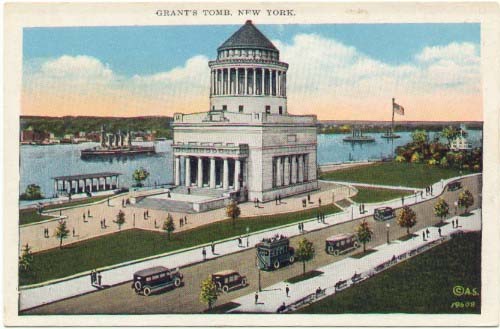
Maybe as my interviews go on, it would be more useful to see what people who are somehow related to Grant’s Tomb wish to talk about instead of Grant’s Tomb. If Grant’s Tomb is so much a symbol that it’s barely a real space, maybe that’s the topic that should be researched, rather than trying to uncover that relationship to see what’s under it. Then again, I really hate symbols precisely because they look beyond the thing, rather than at it. Maybe the real work of my follow-up interviews will be to bring people back to the place—maybe to literally make people walk around through the space—to confront its realness, its monstrous shape, its silent residents: Mr. and Mrs. Ulysses S. Grant.


November 12, 2009

Photography Workshop

A few of Janelle Covino’s ideas about the uses of photography in oral history were really inspiring, especially her outline of how photographs can be used to document the process of interviewing, which includes getting to the interview, researching the person, corresponding—in general, collecting and creating artifacts that add to the contents of the interview.

I also really like Janet Cardiff’s audio walks. After listening to a few excerpts from her website, I wish that there were fewer explanations of emotions, and somehow the evocation of memories seems a little wrong to me—I guess I wish she spoke in the first person instead of the second. But the overall idea of multidimensional audio and retracing paths is really exciting to me. The National Park Service recently started doing audio tour podcast projects, and I have listened to some of the tours for lower Manhattan for the New Amsterdam Tour. Steve Laise narrates on these tours, which is a little funny to me—as if I haven’t listened to this person’s voice enough!


♥ What is the image’s documentary potential? How does it present fact to the world?

- August Sander, The Last People

- Reneke Dykstra, The Bathers
♥ Does the image contribute to the audio? Does it express posture, body?

♥ Does the image display an artifact? How can a person be defined by objects?

- impact on the grass: traces of the body

♥ Does it illuminate the environment of the interview?

♥ Does it convey the passage of time?

- Nicholas Nixon, The Brown Sisters

♥ Does it convey my relationship to obtaining information?

- route to a person or place

♥ Does it represent content: symbol of the past, symbol of memory?

- Gerhard Richter

- Alan Berliner, Family Album

- Janet Cardiff, Her Long Black Hair walk


November 4, 2009

Life History Interview: Update

Unfortunately, I learned today that B has left GH and I won’t be able to do a follow-up interview with her. I’m not sure how much GH was her choice or how much it was required treatment, but I do know that she—to her understanding—doesn’t have a family or a home to go back to. So where she has gone and why she chose it is certainly a source of concern for me.

I really felt like the whole experience of working with clients at GH was a failed attempt to develop a mutually beneficial relationship. Instead it felt stronger as a concept than as a real exchange. Part of this, for me, stems from the way the interviews were introduced (or rather, not introduced) to the clients by GH staff. I don’t appreciate how I was tacit in treating these women like children, who were directed minute by minute throughout their day by people in charge. While I understand that structure is important, there is a difference between enforcing a structure for one’s benefit and enforcing a structure because of an underestimation of one’s capabilities.

Also, the experience of trying to get in touch with B through her counselor made me feel like I was bothering GH, rather than communicating my interest in Barbara as a person and her ability to teach me about herself and about my own abilities and shortfalls of oral history interviewing. It began to feel like a battle between institutions—Columbia and GH—and each institution’s agenda and priorities, and I as a student, and B as a client, were really dwarfed by this larger push and pull.

My experiences working at small non-profit organizations has shown me that there’s a huge difference between the stages of Project Design and Project Implementation; what’s added between those stages is audience and actors. Bringing in the people who are supposed to benefit from a project can be the point where a project becomes more of a hollow framework and less of a well-supported concrete strategy for development and change. I say this not so much because my experience working with B and GH failed to teach me anything (it taught me very much), but because it reminded me too much of struggles I have had organizing projects in my own experience. I guess I feel like I’m able to deal with the reality; that’s my job as a human being. As a student, however, I’m in this program to learn ideals and goals within the context of the discipline from my instructors, and to be able to follow those goals and ideals without being overwhelmed by institutional shortcomings. The necessity to engage these ideals with the world (and project partners, et al) is a constant dialectical process that I understand will go on forever, but moreso in the professional field than within the classroom. I would like to avoid feeling burned out as a student of a discipline before ever getting to practice the discipline.

But perhaps most importantly, it’s hard to describe the sense of loss I feel knowing that my contact with B has ended, and that her future is so uncertain. It would have been hard enough for me to complete the interview series and hear about her struggles even within the context of a full interview and follow-up. But the way our interaction ended so suddenly has left me fearing that I tried and failed to help her, and that my responsibility to her is unfulfilled.

November 2, 2009

Grant's Tomb Project Interview: Session One

I interviewed SL, who is the National Park Service Chief of Cultural Resources for the NYC Harbor Parks, Manhattan Sites. This was my first interview for my Project Design in Method & Theory, which deals with the history of the General Grant National Memorial. SL calls himself the “Parks Historian,” and he agreed to talk to me about the history of Grant’s Tomb and its relationship to the Civil War. He admitted that he didn’t have a lot of knowledge of the restoration of the Tomb in the 1990s, but I was still interested in what he had to say about the Tomb in a larger historic context. I was worried that he wouldn’t be present in his narrative—both because he was more compelled to participate in the interview because of the opportunity for him to talk about Civil War history (during which time he obviously wasn’t alive!), and because he had explicitly told me that he wasn’t comfortable providing his personal history.

So instead of giving me a narrative that detailed his actions throughout history, he gave me something else, in which I think he is entirely present, albeit in a rather complex way. He gave me very rich responses to how he relates to history and place, in both explicit and subtle ways. But the way he gave it—that is, through his interpretation of history—is something that I’m not entirely sure I know how to deal with because it isn’t firsthand. But it is as close to firsthand as possible, and I think that his motivation for talking about history and researching events, places and artifacts is to experience history in a way that simulates firsthand experience. I think that this is something that’s really unique—I don’t know how my fellow students or my instructors will think about this. Is it an utter failure to interview someone about events that preceded their birth?


Aside from the premise of the interview possibly being problematic, I know for sure that some of my questions were way too long—or at least too explicitly full of my struggle to launch my question from a particular idea. Mary Marshall has talked about putting our idea into our question, but I realized I have a tendency to state my reasoning for asking a question before stating the question. So I have definitely not mastered the two-sentence question; a few times I was just thinking out loud (which is so clear in the transcript). Also, my attempt to talk a bit about myself in order to encourage him to respond in kind came off more like a perso
nal indulgence than a way to set the stage for the type of narrative I wanted him to provide—that’s also something that I need to work on, though I wonder if all this is aggregating and could work to my advantage in a future interview.

One of the questions he responded to without my asking related to whose stories were excluded from the General Grant National Memorial, which he explained were the stories that addressed the continuing struggle of the formerly enslaved African and African-American people and their descendants. In this way, the Memorial is very clearly a monument to an idea—that the Civil War was a worthwhile and valiant moral battle—rather than to the realities of rebuilding infrastructure and dealing with the manifestations of a still-present racism within that new infrastructure throughout the South and the North as well.

It’s interesting that the structural renovation of Grant’s Tomb, as well as its organizational infrastructure, were both major topics in my original project design. Yet those are not the topics that people seem to want to discuss. Just like the details that make the story of the Civil War such a horrifying experience, maybe the specifics of the Tomb’s restoration combine to form a story that no one really wants to talk about. The Tomb seems—in a lot of ways, and despite its enormous physical presence—to be a springboard for a discussion of ideas and intention, and less a place for the discussion of concrete (literally, in this case) events.

Why is Gra
nt’s Tomb so much more of a symbol than a real space? Does anyone ever even go inside it? Maybe that’s the beginning of the problem!